Google May 2026 Core Update Explained: Key SEO Changes and Recovery Tips
The Google May 2026 Core Update introduced significant changes to search rankings, content evaluation, and user experience signals. In this guide, we break down the key SEO changes, analyze their impact on websites, and share practical recovery strategies to help businesses, publishers, and marketers maintain or improve their organic search performance
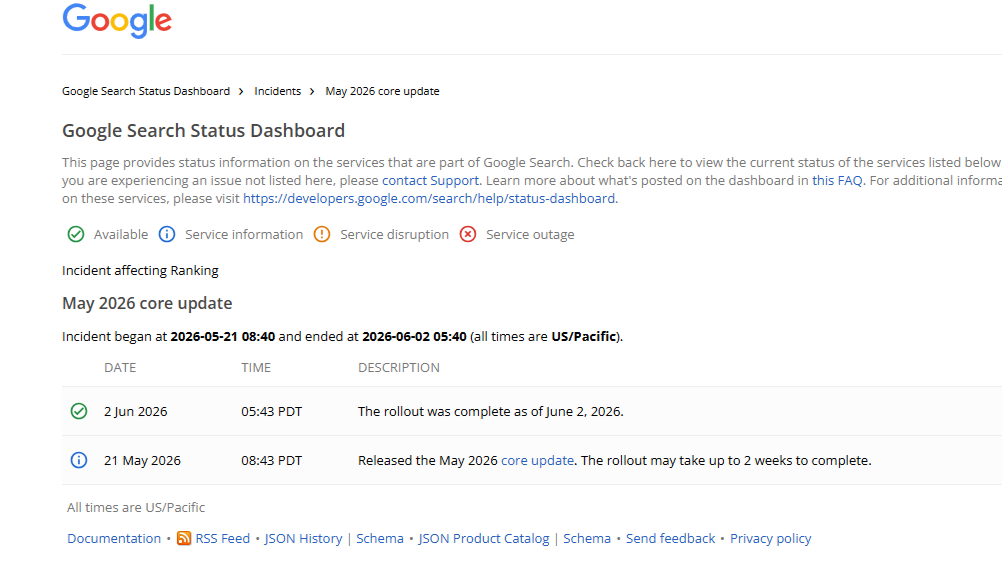
Thursday, May 21, 2026, it began – on June 2, 2026, it was over. Google marked the May 2026 Core Update as officially complete after roughly twelve days. The entry in the Google Search Status Dashboard is unambiguous: “The rollout was complete as of June 2, 2026.” The second confirmed broad core update of 2026 is done – and the phase in which reacting would only have produced noise is over.
The start fell on a notable moment: just 48 hours after Google I/O 2026, where Google presented what it described as one of its largest Search upgrades in years. Whether there is any substantive connection between the I/O announcements and this core update has not been communicated by Google. The timing is still worth noting.
In this article: The confirmed key dates for the completed May 2026 Core Update, the documented volatility course, the DACH status, the Google I/O 2026 context – and above all, how to cleanly analyze now whether your site was affected.
The Facts: Start, Duration, Completion
Key Takeaway:
- Start May 21, 2026, completion June 2, 2026 – roughly twelve days of rollout. Both the announcement and the completion ran exclusively via the Google Search Status Dashboard and the Search Central account on X and LinkedIn, with no companion blog post. Google framed the update as a regular measure, not a special case.
- The official announcement came directly via the Google Search Status Dashboard. The start entry from May 21, 2026, 8:43 AM PDT reads: “Released the May 2026 core update. The rollout may take up to 2 weeks to complete.” Exactly twelve days later, on June 2, 2026 at 5:43 AM PDT, the completion entry followed: “The rollout was complete as of June 2, 2026.”
There was no companion blog post, neither at launch nor at completion. This is now Google’s standard approach for broad core updates – the March 2026 Core Update was identical in this regard, with no supplementary document outlining update goals or affected sectors.
| Parameter | Details |
|---|---|
| Start date | May 21, 2026, per Dashboard entry around 8:40 AM PDT (5:40 PM CEST) |
| Completion date | June 2, 2026, 5:40 AM PDT (2:40 PM CEST) – officially confirmed |
| Rollout duration | Roughly 12 days (within the announced two-week window) |
| Update type | Broad Core Update (Ranking) |
| Affected systems | Google Search Ranking – global, all languages |
| Official sources | Google Search Status Dashboard, Search Central X/LinkedIn |
| Companion blog post | None |
Tip: The Google Search Status Dashboard at status.search.google.com remains the only official real-time source for update status and completion confirmation. For analysis: the completion date logged there (June 2) is the anchor point from which you count the waiting period until reliable analysis.
Rollout Complete: Timeline and Volatility Course
Key Takeaway:
- The rollout ran from May 21 to June 2, 2026 and was marked by several volatility spikes – per industry reports especially on May 23, around May 30, and again in the 24 hours before completion. Google itself published no winners/losers profile and only reiterated its standard note that site owners need not do anything special.
Fact (primary source): In the Google Search Status Dashboard the incident now shows as “Resolved.” Per the entry, it ran from 2026-05-21 08:40 to 2026-06-02 05:40 (times in US/Pacific). The completion note from June 2, 2026, 5:43 AM PDT reads verbatim: “The rollout was complete as of June 2, 2026.”
The course at a glance – the key documented milestones of the rollout:
| Time | Event |
|---|---|
| May 21, 8:43 AM PDT | Start entry in the Dashboard, rollout begins |
| May 23 (Saturday) | First strong ranking movements per industry tools (source: Search Engine Land) |
| around May 28–30 | Visibility peak and emerging trend reversal; renewed high volatility (sources: SEO Südwest, May 29; Search Engine Land) |
| June 1–2 | Renewed volatility in the 24 hours before completion (source: Search Engine Land) |
| June 2, 5:43 AM PDT | Completion entry in the Dashboard: “complete as of June 2, 2026” |
Industry observation (attributed):
- SEO Südwest reported an emerging trend reversal on May 29, 2026. According to that report, many websites in the ongoing core update were giving back “part of their gains” – though the documented examples still netted a clear increase. The pattern described: a visibility peak around May 28, followed by a decline the next day. (Source: SEO Südwest, May 29, 2026)
Important context – visibility is not traffic:
- The same analysis documented cases where visibility rose by more than 50 percent without clicks following suit. This is a recurring misunderstanding: visibility indices like Sistrix or Semrush are extrapolated ranking estimates across a keyword set – not a measurement of actual clicks. What ultimately holds up is the before-and-after comparison of your own Search Console data.
Striking across the entire rollout window – desktop and mobile diverged sharply:
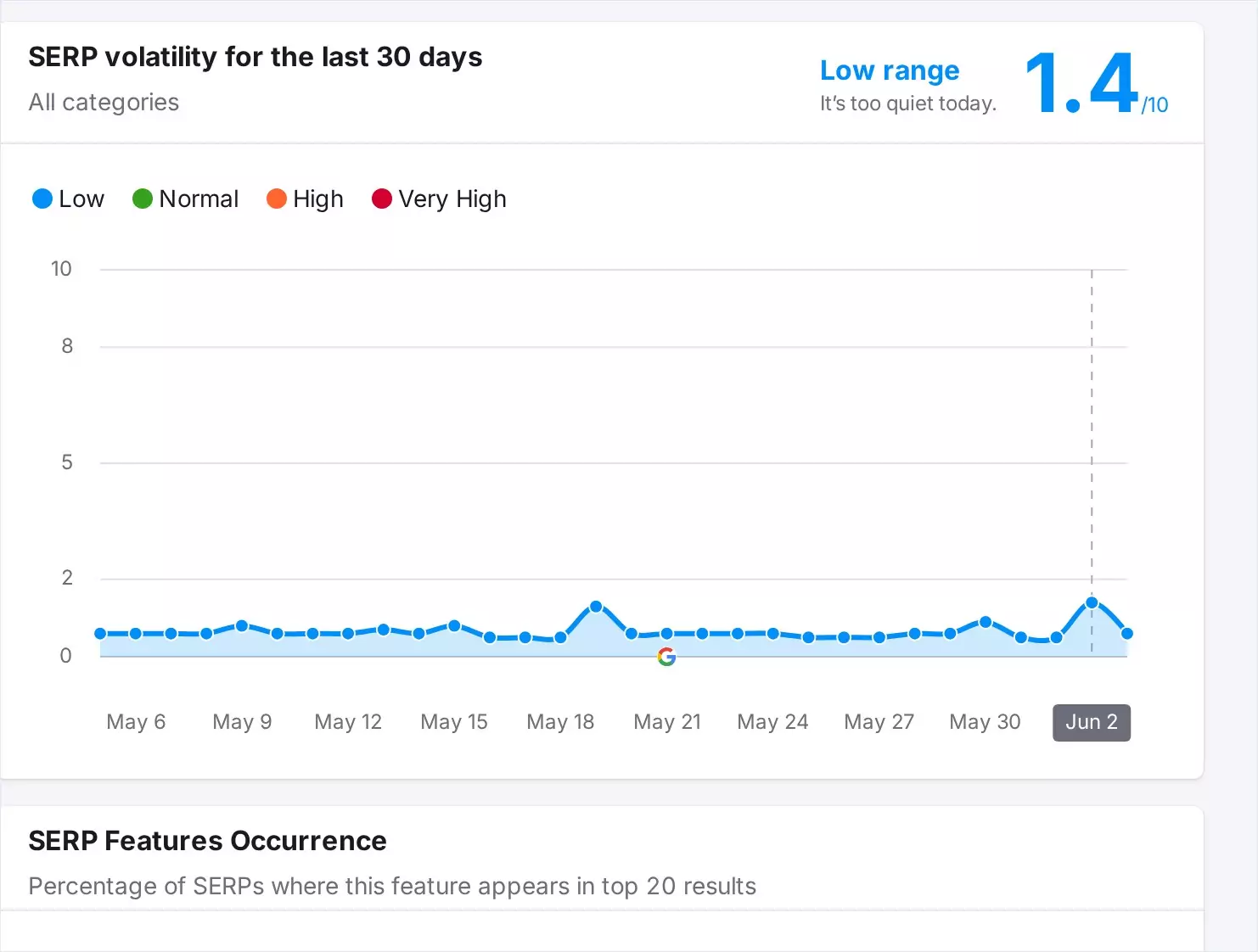
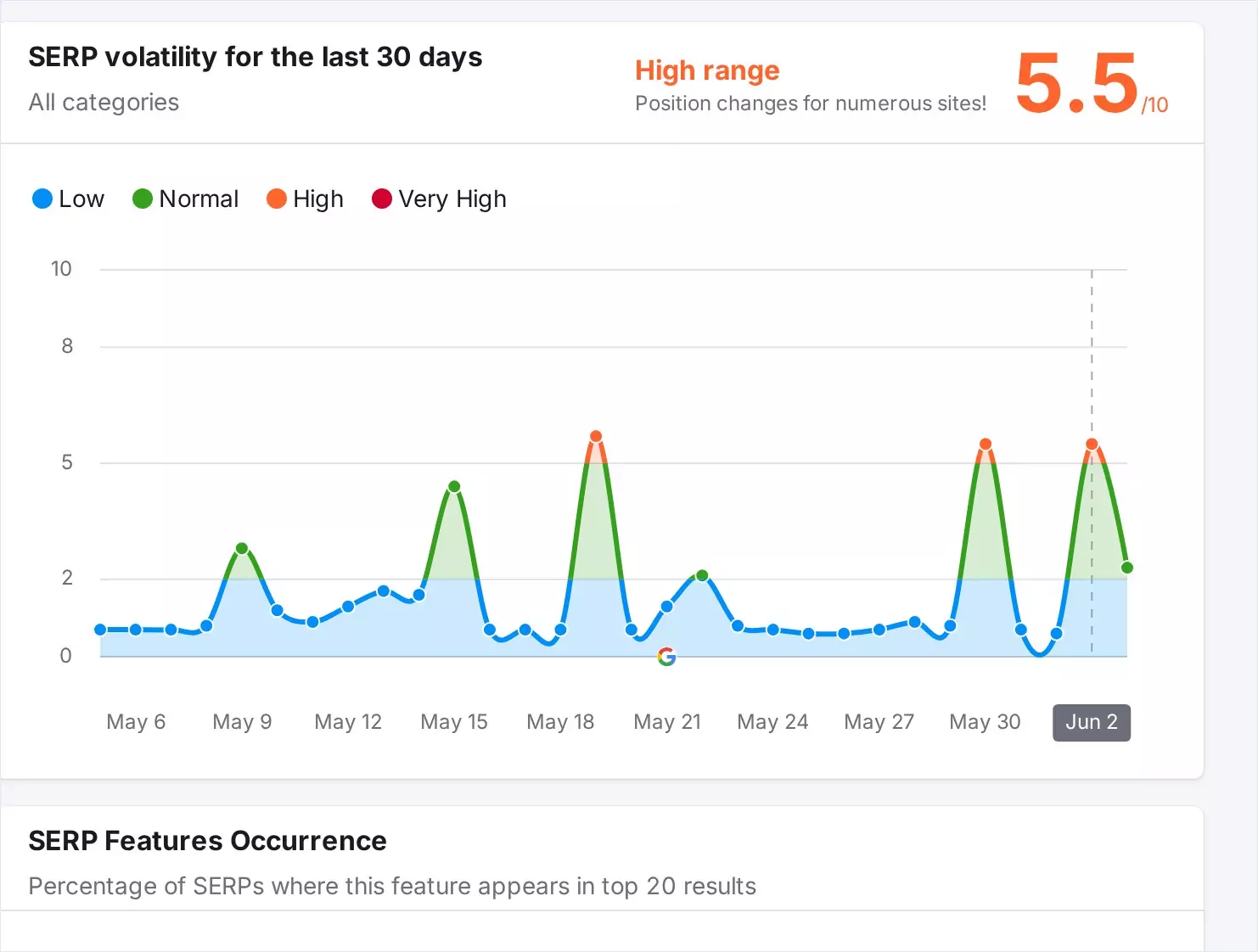
- The Semrush Sensor for the Germany database (all categories) shows a clear pattern over the 30-day window. Desktop stayed consistently low (peak around 1.3, at 1.4 on June 3 – “Low range”), while mobile repeatedly jumped into the “High range” – with spikes around May 18, May 30, and again on June 1-2, still at 5.5 on June 3. Mobile volatility was thus several times higher than desktop for long stretches. Anyone watching desktop rankings only may, in my assessment, have missed the larger part of the movement – especially in the mobile-dominated DACH traffic. (Source: Semrush Sensor, Germany, all categories, 30-day course, as of June 3, 2026)
What Google said at completion:
- A substantive recap or a profile of affected sectors did not materialize. Google merely repeated its standard framing – the update was “a regular update designed to better surface relevant, satisfying content for searchers from all types of sites,” and there was “nothing new or special that creators need to do” as long as they make satisfying content for people. (Source: Google Search Central / Search Engine Land)
My take:
- The repeated cycle of rise, pullback and renewed movement right up to the finish is exactly why reactive re-optimizing during a rollout is rarely wise. Anyone who had “course-corrected” in late May based on a visibility gain might have optimized toward an interim result that looked different again by June 2. Now, after completion, analysis finally makes sense.
Timing and Context: Google I/O 2026
Key Takeaway:
- The May 2026 Core Update started two days after Google I/O 2026 – close in timing, but no confirmed substantive connection. Google presented what it described as major Search upgrades at I/O. The context matters for understanding the ranking environment, independently of the update itself.
On May 19, 2026, Google held the I/O keynote. Elizabeth Reid, VP of Search, published the blog post “A new era for AI Search” (Google Blog, May 19, 2026). Then, two days later, the core update. Coincidence? Likely. But the context is still relevant for how you interpret the ranking environment going forward.
What Google communicated at I/O 2026, according to the official Google blog post:
On May 19, 2026, Google held the I/O keynote. Elizabeth Reid, VP of Search, published the blog post “A new era for AI Search” (Google Blog, May 19, 2026). Then, two days later, the core update. Coincidence? Likely. But the context is still relevant for how you interpret the ranking environment going forward.
What Google communicated at I/O 2026, according to the official Google blog post:
AI Mode:
- Google states that AI Mode surpassed one billion monthly users within one year of launch. According to Google, queries more than doubled every quarter. Now globally available in all supported countries and languages.
Gemini 3.5 Flash:
- New default model in AI Mode worldwide – Google describes it as delivering “sustained frontier performance for agents and coding.”
Information Agents:
- 24/7 background agents that continuously monitor the web based on user-defined criteria and deliver synthesized updates. Launching summer 2026 for Google AI Pro and Ultra subscribers.
Search box redesign:
- According to Google, “the biggest upgrade to our Search box in over 25 years.” Now supports text, images, files, videos, and Chrome tabs multimodally.
Personal Intelligence:
- Expanded to nearly 200 countries and territories in 98 languages – no subscription required.
My take on the timing: Core updates and feature releases follow different development cycles at Google – the two-day gap is most likely coincidental. What I can say: the search context in which this core update operates has shifted through the I/O announcements. Anyone treating AI Mode as a fringe phenomenon is, in my view, assessing their ranking landscape only partially.
1. Google’s Still All About Helping Users
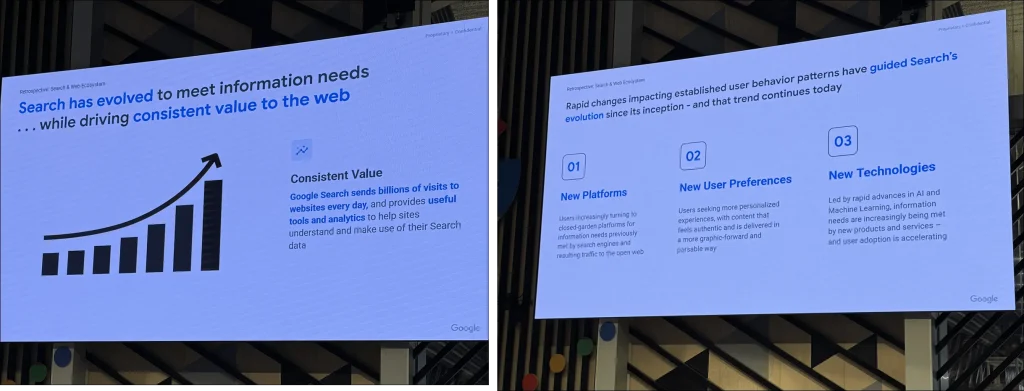
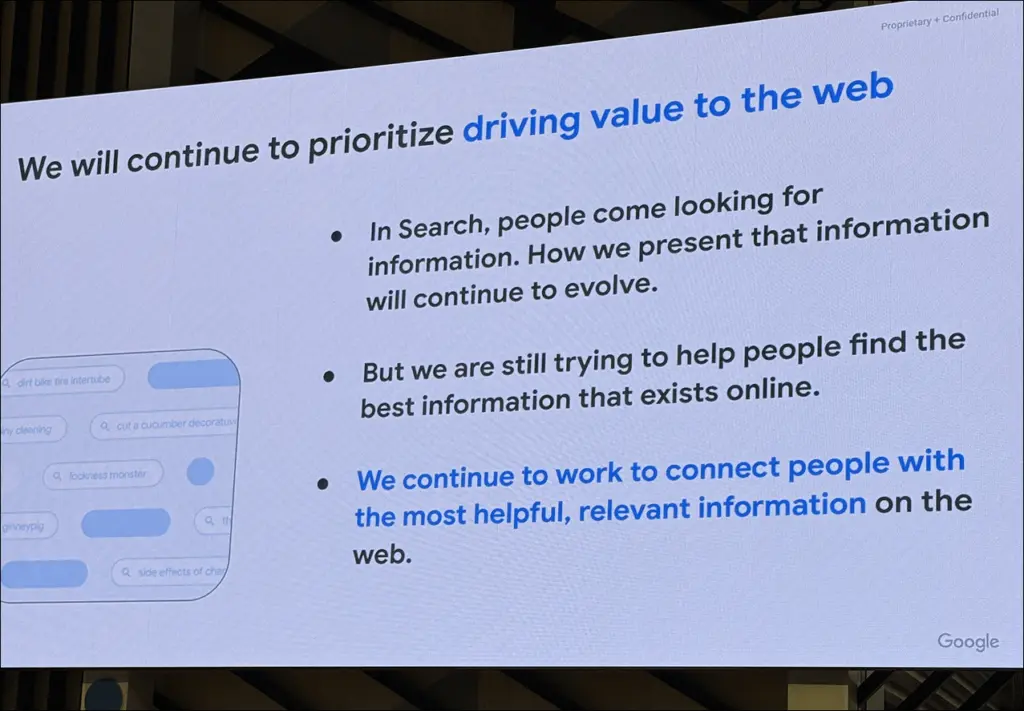
Google made it crystal clear: their number one goal is to give users the best experience possible. Even with all the fancy AI stuff happening, search isn’t “done” yet. New platforms, changing user habits, and cool tech keep popping up, so Google’s always working to stay ahead. They’re also helping website owners with tools like Google Search Console and Google Analytics to drive traffic and grow online. Pretty user-friendly, right?
2. AI Content? No Problem, If It’s Helpful
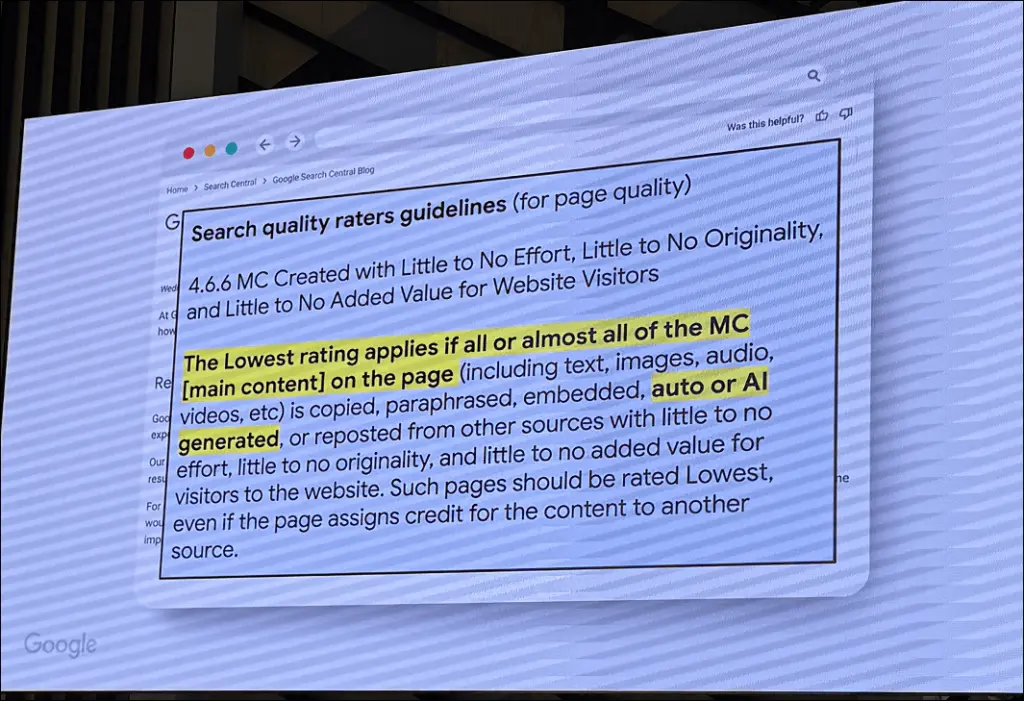
Wondering if you can use AI to create content? Google’s John Mueller said it’s totally fine, as long as it’s valuable for your audience. But here’s the catch: if your AI-generated content is just fluff or trying to trick search engines, Google’s quality checkers might flag it as low-quality. This comes from their updated January 2025 guidelines. So, focus on creating stuff that actually helps your readers, and you’re good to go!
3. How AI Search and AI Overviews Function and Optimization Strategies
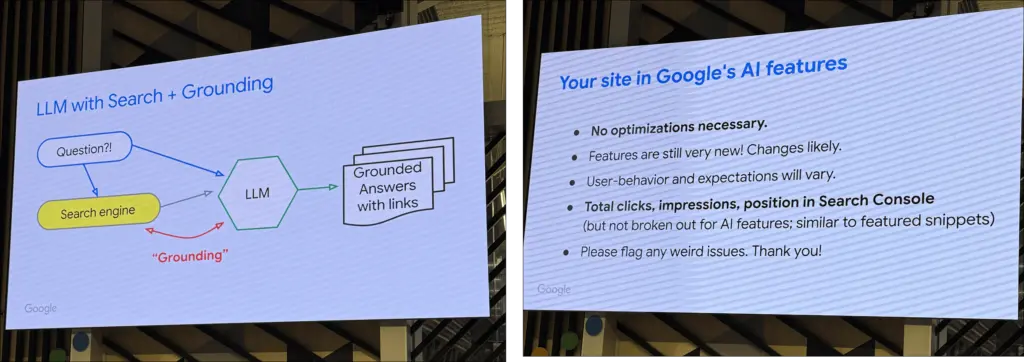
John Mueller detailed the integration of Large Language Models (LLMs) with search using Retrieval-Augmented Generation (RAG) and the grounding process for AI Overviews. He noted that opting out of AI Overviews is possible via the robots “nosnippet” configuration, as Google treats them as a search feature. Mueller clarified that no specific optimization is needed for Google’s AI features due to their novelty and evolving user behavior. However, he recommended using structured data for its efficiency and readability, focusing on elements visible in Search Engine Results Pages (SERPs).
Regarding LLMs.txt, Mueller explained it may be relevant for systems unfamiliar with a site but is unlikely to be considered by Google, given their extensive site data. Currently, no AI systems are known to use LLMs.txt. Additionally, Google’s extended robots.txt controls allow management of content used for training Gemini and Vertex AI. This is a user-agent token, not a crawler, and does not impact search indexing or rankings.
4. Keeping an Eye on AI Overviews Is Tricky
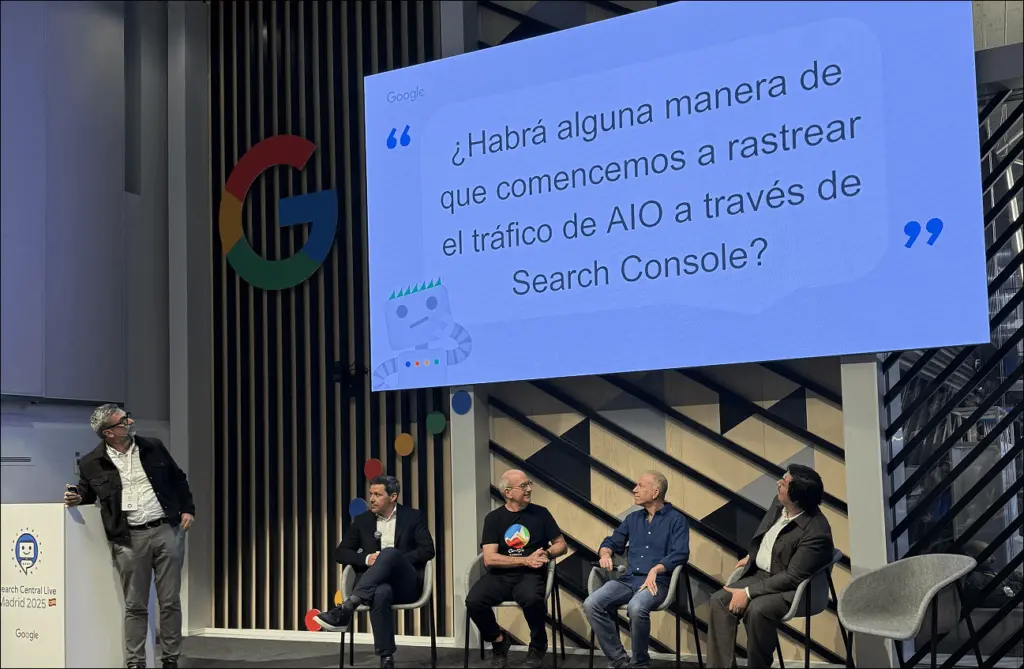
Want to know how AI Overviews are affecting your site? It’s not easy right now because Google Search Console doesn’t give much data on this. But don’t worry, Google’s working on better tracking tools, like updating data every hour, to help you see what’s going on. For now, just keep creating great content and stay tuned for updates!
5. The Future of Search Is AI + Classic SEO
AI is shaking things up, but Google says the basics of SEO (like making sure your site is crawlable and indexable) are still super important. Think of it like this: AI is the shiny new toy, but the old-school SEO tricks are the foundation that keeps everything running smoothly. So, keep up with both to stay ahead in the game.
Why This Matters
The news from this Madrid meetup shows that Google is doubling down on AI while keeping users and website owners in mind. At Creatify, we’re excited to see how these changes will shape the future of search. Whether you’re a blogger, a business owner, or just curious about SEO, these insights are a reminder to focus on creating awesome content that people love.
Was this article helpful?